Mobile mammography units making a difference in overall cancer screening
April 27, 2026, 3:40 pm
Kara Kinna


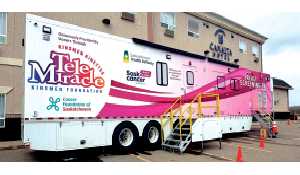
The Saskatchewan Cancer Agency’s and Sask Health Authority’s Mobile Mammography Unit was in Moosomin last week and will be in Broadview from April 27 to May 8 and Grenfell from May 11-22.
The province of Saskatchewan recently announced funding for a second mobile unit which is already on the road in communities around Saskatchewan.
The World-Spectator spoke with Richard Dagenais last week, SHA’s Vice President of Clinical Support Services. Dagenais explained how the units are making a difference around Saskatchewan and how women can access screening through them. The interview with Dagenais follows.
What’s different between these units and the older unit that used to be on the road?
“The mobile unit that was out there previously was a bus. It’s the same sort of bus that you might see a hockey team use, but it’s been refitted. It was refitted to support the mobile breast screening. I want to be clear—that unit served us very well for many, many years. That unit served for over 20 years, but technology gets dated after that long. The bus was beginning to show signs of wear, and it was becoming more expensive to maintain and keep on the road. So when we took a look at the new units, we elected to move from a bus to a semi trailer.
The new unit is more spacious, with more room for patients to change, more room to interact with the technologists, and of course has updated technology. One of the advantages of it being a trailer as opposed to a bus is it eliminates any complications around mechanical issues. When you have a bus, if there’s a problem with the bus itself, you need an auto mechanic. With the trailer, we have a variety of people who might be able to support us in terms of getting it from one place to the next.
How does the program work? How can women make an appointment and how early can women make and appointment? And where can women go to find out where the bus will be?
To go in for a screening, I would direct women to go to the breast check website at the saskcancer.ca website.
The breast screening program, including the mobile breast screening program, is run jointly between the Saskatchewan Cancer Agency and the Saskatchewan Health Authority. The Saskatchewan Cancer Agency, part of the role they play is they advertise the program, and they also do the bookings, and so you can get a good deal of information through their website.
Appointments for the mobile unit can be made about six weeks ahead of the unit arriving at a site, and the Cancer Agency does endeavor to make sure that those visits are communicated in the communities where folks are going to be.
Screening it currently for women 43 and up. If somebody under the age of 40 is wanting to be scanned, how can they do that?
Currently it’s available for women aged 43 to 74 and starting this summer, that’s going to be expanded so that women between ages of 40 and 74 will be able to be screened.
Breast screening is really designed for asymptomatic women, so if there’s no signs or symptoms or no specific concerns. If a woman does have a specific concern and she would like to get a mammogram at a younger age, we would encourage her to speak to her family physician, and they could arrange for her to have a diagnostic mammogram at one of the other sites across the province.
How many women can these mobile units see in a day?
The number of patients the unit sees on average every day is usually around 50, depending of course on weather conditions, what day of the week it may be, and so on.
What difference is that second unit going to make for rural communities around Saskatchewan?
That second unit is actually already on the road. It’s currently in Wynyard, and will soon be heading to Lanigan.
When we had one unit, it allowed us to visit each of the 42 communities that we serve once every two years. Having the second unit will allow us to visit each of those communities once a year. With the expansion over the last few years of the breast screening age of availability from women 50 to 74 to women 40 to 74, there’s a lot more participants in the breast screening program, and having that second bus and being able to visit those communities every year will support us in keeping up with the demand for breast screening.
How many screenings are doing a year now, and how many will you be able to do with the second unit?
With both busses on the road, we’ll be able to see about 15,000 breast screening patients a year. That’s not quite double what we’ve been seeing previously.
Are two units enough? Or will you be looking at adding more at some point?
At the moment, we don’t have any plans to add additional units. It’s important for everybody to understand that in addition to those two units, we have dedicated breast screening sites in Saskatoon and Regina. We also have fixed mammography sites at hospitals in Swift Current, Moose Jaw, Yorkton, North Battleford, Lloydminster, and Prince Albert, and so among all of that, we believe that what we have now will support us in meeting the demand.
But we always monitor demand and our ability to provide the service very, very closely, and when we need to, we expand hours, and if the demand continues to be there, we would certainly continue to review and assess it.
How do these mobile mammography units fit into the overall cancer program in Saskatchewan?
Mobile mammography is designed for women who don’t have symptoms, and by having regular screening, it allows us to pick up cancers or potential cancers far earlier. And really, the earlier we can identify a potential cancer, the better the treatment outcomes, the faster we can begin treatment.
It’s just so much better in terms of us providing timely care to our patients. So it’s really key in ensuring we can be as effective as possible in catching and treating cancer.
Is this something that other provinces offer, or is the mobile mammography program something that’s unique to Saskatchewan?
It is not unique to Saskatchewan. There are other jurisdictions in Western Canada that offer it.
Is there potential for the mobile model of care to be expanded to other health care services?
We certainly want to make sure that we’re providing effective services close to home for people across the province. And the idea to provide service with this kind of model is certainly something we look at. At the moment, there are no immediate plans for any other services.